Research Theme

Federal Resource Allocation

Research on how federal attention, grants, disaster declarations, and public resources move across communities.

Federal Resource Allocation Publications

Publication Type

Research Pathways

2022 Article

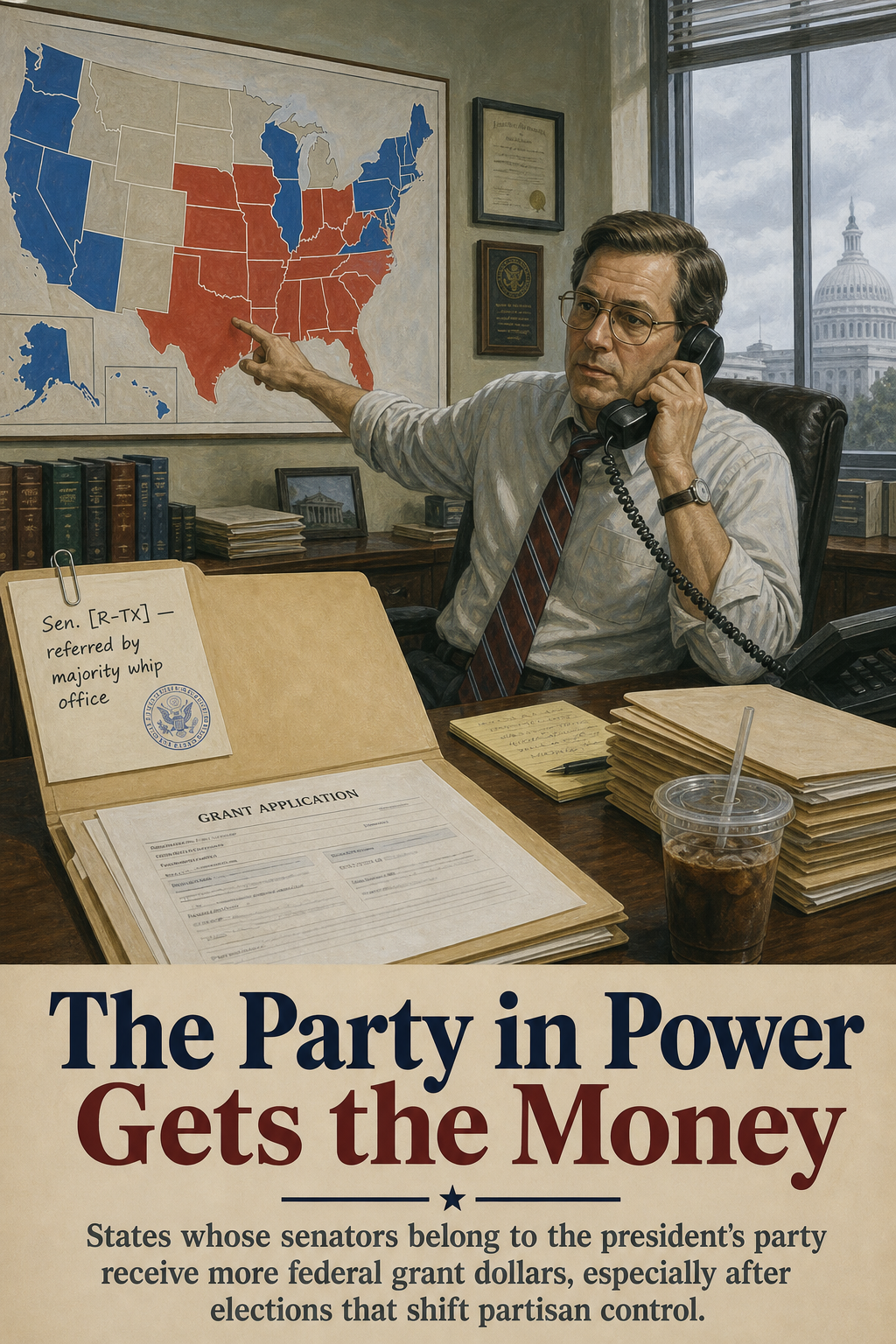
Partisanship, Trump, and the Normative Implications of Presidential Particularism: A Response to Pasachoff’s Executive Branch Control of Federal Grants

Ohio State Law Journal Online · 2022

Douglas Kriner, Andrew Reeves

This article responds to Pasachoff’s analysis of executive branch control over federal grants, discussing the normative and empirical implications of presidential particularism, especially in the context of partisanship and the Trump administration.

Featured visual from Partisanship, Trump, and the Normative Implications of Presidential Particularism: A Response to Pasachoff’s Executive Branch Control of Federal Grants
2021 Article

Public Opinion and Public Support in Crisis Management

Encyclopedia of Crisis Analysis · 2021

Zoe Ang, Benjamin Noble, Andrew Reeves

This article examines how public opinion and electoral incentives shape crisis management responses by political leaders, especially U.S.

View abstract +

In times of crisis, citizens look to their leaders for aid and assistance. In the democratic context, the focal figure is likely the chief executive accountable to the whole of the nation. With a specific focus on the American president and the incidences of natural hazards, public opinion and governmental response to these crises are analyzed. While one may expect such a universal actor to aid each according to their need, new scholarship finds that voter behavior and electoral institutions incentivize the president to support only a small slice of the electorate. Empowered by federal disaster relief legislation in the 1950s, the president targets electorally valuable voters when disbursing aid or allocating resources in response to disaster damage. Voters in those areas respond myopically and tend to vote for the incumbent for reasons ranging from economic to emotional. Thus, elites anticipate voter reactions and strategically respond to disasters to mitigate blame or punishment for the event and capitalize on an opportunity for electoral gains.

Featured visual from Public Opinion and Public Support in Crisis Management
2015 Article

American Political Science Review

Presidential Particularism and Divide-the-Dollar Politics

American Political Science Review · 2015

Douglas L. Kriner, Andrew Reeves

Presidents target federal grant spending toward politically important constituencies, including swing states and core partisan counties.

View abstract +

In a county-level analysis of federal spending from 1984 to 2008, we find that presidents are not universalistic, but particularistic—that is, they reliably direct dollars to specific constituents to further their political goals. Presidents target both counties within swing states and counties in core states that strongly supported the president in recent elections. Swing state particularism is especially salient during presidential reelection years, and core partisan counties within swing states are most heavily rewarded. Our results suggest that presidents systematically prioritize the needs of politically important constituents rather than strictly pursuing visions of good public policy or pandering to the national median voter.

Featured visual from Presidential Particularism and Divide-the-Dollar Politics
2015 Chapter

The Politics of Disaster Relief

Emerging Trends in the Social and Behavioral Sciences · 2015

Alexander Oliver, Andrew Reeves

This essay reviews research on how voters and politicians in the United States respond to severe weather events, highlighting key findings and future research directions in the politics of disaster relief.

View abstract +

This essay provides an overview of the research on the politics of disaster relief in the United States, focusing on the response of voters and politicians in the aftermath of severe weather events. It reviews foundational research, discusses recent advances, and addresses important issues for future research on this topic.

Featured visual from The Politics of Disaster Relief
2013 Article

Driving Support: Workers, PACs, and Congressional Support of the Auto Industry

Business and Politics · 2013

Ryan T. Moore, Eleanor Neff Powell, Andrew Reeves

The presence of auto workers in a congressional district, not just PAC contributions, strongly predicts legislative support for auto industry bailouts and targeted aid, but this influence does not extend to broader legislation.

View abstract +

In 2008 and 2009, the House of Representatives directed billions of dollars to the auto industry by passing a bailout and the “cash for clunkers” program. Moving beyond corporate influence via campaign contributions, we demonstrate that the presence of auto workers in a district strongly predicts legislative support for both bills. In addition to this critical legislation, we also analyze over 250 bills on which the auto industry either lobbied or took a public position. We find no patterns relating a district’s workers or corporate campaign contributions to these votes on broader legislation where other groups, such as environmental advocates or labor unions, are at the table. Instead, the auto industry garners consistent support only on quasi-private, particularistic legislation. Thus, we contend that on particularistic legislation the presence of workers (not just campaign contributions) drives legislative support; however, when legislators expand the scope of conflict, the influence of a single industry is attentuated by other interests.
Featured visual from Driving Support: Workers, PACs, and Congressional Support of the Auto Industry
2012 Article

American Political Science Review

The Influence of Federal Spending on Presidential Elections

American Political Science Review · 2012

Douglas L. Kriner, Andrew Reeves

Voters reward presidents for increased federal spending in their communities, especially in battleground states and when partisan responsibility is clear.

View abstract +

Previous research on the electoral consequences of federal spending has focused almost exclusively on Congress, mostly with null results. However, in a county- and individual-level study of presidential elections from 1988 to 2008, we present evidence that voters reward incumbent presidents (or their party’s nominee) for increased federal spending in their communities. This relationship is stronger in battleground states. Furthermore, we show that federal grants are an electoral currency whose value depends on both the clarity of partisan responsibility for its provision and the characteristics of the recipients. Presidents enjoy increased support from spending in counties represented by co-partisan members of Congress. At the individual level, we also find that ideology conditions the response of constituents to spending; liberal and moderate voters reward presidents for federal spending at higher levels than conservatives. Our results suggest that, although voters may claim to favor deficit reduction, presidents who deliver such benefits are rewarded at the ballot box.

Featured visual from The Influence of Federal Spending on Presidential Elections
2011 Article

American Journal of Political Science

Make it Rain? Retrospection and the Attentive Electorate in the Context of Natural Disasters

American Journal of Political Science · 2011

John T. Gasper, Andrew Reeves

Voters punish presidents and governors for severe weather damage, but reward or punish them more strongly based on their actions in response to disasters, demonstrating that electorates can distinguish between random events and government responsibility.

View abstract +

Are election outcomes driven by events beyond the control of politicians? Democratic accountability requires that voters make reasonable evaluations of incumbents. Although natural disasters are beyond human control, the response to these events is the responsibility of elected officials. In a county-level analysis of gubernatorial and presidential elections from 1970 to 2006, we examine the effects of weather events and governmental responses. We find that electorates punish presidents and governors for severe weather damage. However, we find that these effects are dwarfed by the response of attentive electorates to the actions of their officials. When the president rejects a request by the governor for federal assistance, the president is punished and the governor is rewarded at the polls. The electorate is able to separate random events from governmental responses and attribute actions based on the defined roles of these two politicians.

Featured visual from Make it Rain? Retrospection and the Attentive Electorate in the Context of Natural Disasters
2011 Article

The Journal of Politics

Political Disaster: Unilateral Powers, Electoral Incentives, and Presidential Disaster Declarations

The Journal of Politics · 2011

Andrew Reeves

Presidents use disaster declarations in electorally strategic ways, linking emergency authority to political incentives.

View abstract +

This article argues that presidents use unilateral powers for particularistic aims to gain electoral support, focusing on presidential disaster declarations. An analysis from 1981 to 2004 finds that a state’s electoral competitiveness influences the likelihood of receiving a disaster declaration, especially after the 1988 Stafford Act expanded presidential powers. Competitive states can expect more disaster declarations, and these decisions yield electoral benefits for presidents, who are rewarded at the ballot box for issuing such declarations.

Featured visual from Political Disaster: Unilateral Powers, Electoral Incentives, and Presidential Disaster Declarations