Unilateral Powers, Public Opinion, and the Presidency
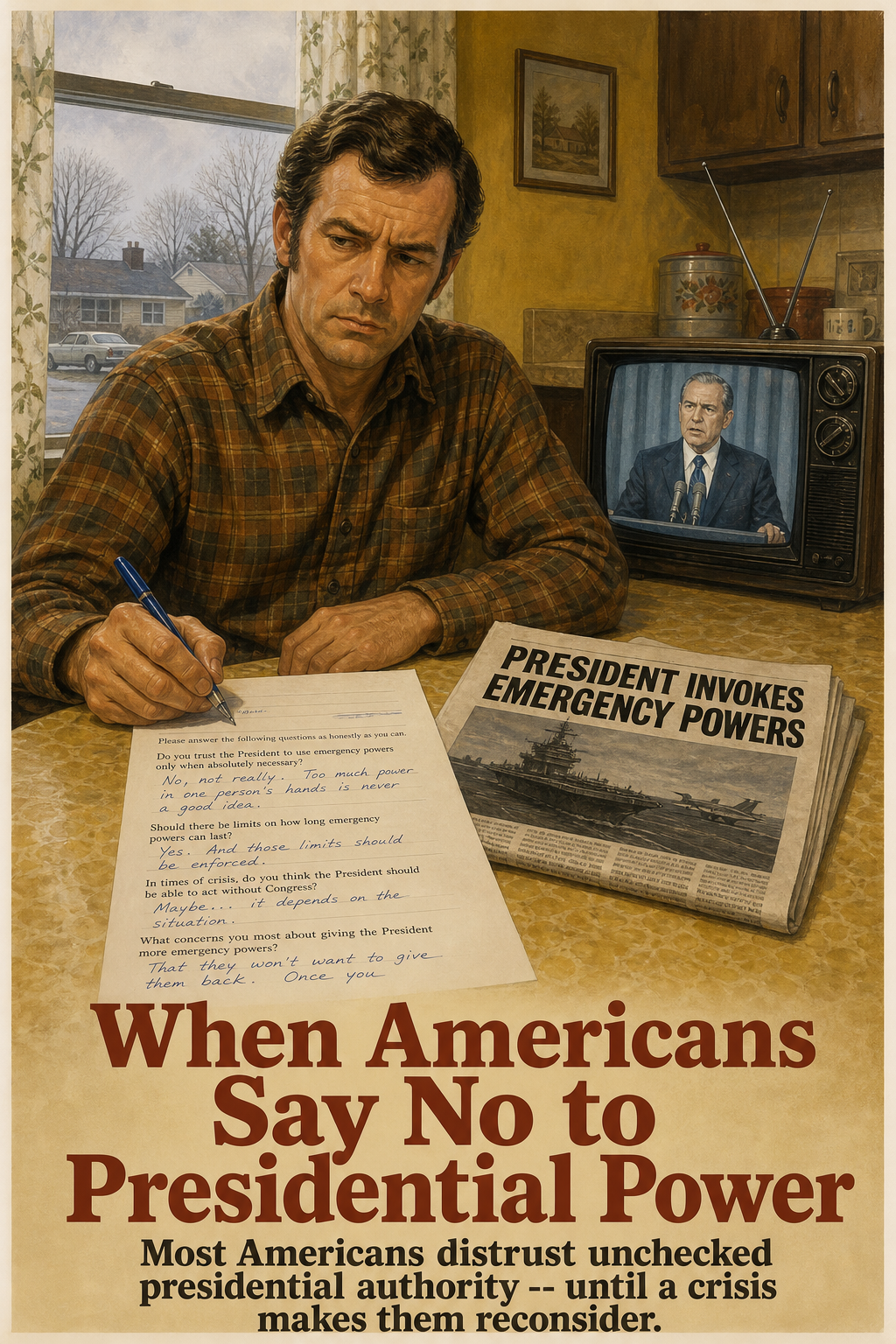
Public support for unilateral presidential powers is generally low, stable, and shaped by both approval of the current president and beliefs in the rule of law, with context further conditioning these attitudes.
Why It Matters
The publication begins with a motivating question: How do Americans view unilateral presidential power, and what factors structure public attitudes toward the president's use of unilateral powers?
Its central contribution is to show that public support for unilateral presidential powers is generally low, stable, and shaped by both approval of the current president and beliefs in the rule of law, with context further conditioning these attitudes.
It matters because the findings connect institutional choices to the way authority, public responsibility, and political behavior are experienced in practice.
Key Findings
- Support for unilateral presidential powers is generally low among the public.
- Attitudes toward unilateral powers are stable over time.
- Support is structured by both presidential approval and beliefs in the rule of law.
- Political context, such as national security or congressional inaction, increases support for unilateral power.
- Attitudes toward unilateral power influence evaluations of policies achieved through such means.
Research Design
- Design
- Article
- Data
- 2013 Cooperative Congressional Election Study (CCES); The American Panel Study (TAPS); Survey Sampling International (SSI) survey (September 2014); Economist/YouGov survey (February 2015)
- Geography
- United States
- Time Period
- 2013–2015
- Unit of Analysis
- individual survey respondent
- Methods
- Four nationally representative surveys (2013–2015) measuring attitudes toward unilateral powers.; Survey experiment manipulating political context (e.g., national security, congressional inaction).; Logistic regression models to analyze correlates of support for unilateral powers.; Analysis of policy evaluation using survey data on specific executive actions.
Full Abstract
This article explores mass attitudes toward unilateral presidential power. We argue that mass attitudes toward presidential power reflect evaluations of the current president as well as more fundamental conceptions about the nature of the office, which are rooted in beliefs about the rule of law. In four nationally representative surveys, we find low levels of support for unilateral powers, that these attitudes are stable over time, and that they are structured both by presidential approval and beliefs in the rule of law. In a fifth survey, we show that political context conditions support for unilateral power, and in a sixth we show that these attitudes are consequential for policy evaluation. Even during the Obama presidency, when presidential power is highly politicized, voters distinguish the president from the presidency. Our results have important implications for public opinion’s role in constraining the use of presidential power.
Citation
Reeves, Andrew, and Jon C. Rogowski. 2016. "Unilateral Powers, Public Opinion, and the Presidency." The Journal of Politics 78(1): 137-151. https://doi.org/10.1086/683433
- Venue
- The Journal of Politics
- Volume
- 78
- Issue
- 1
- Pages
- 137-151
- DOI
- 10.1086/683433