The Contextual Determinants of Support for Unilateral Action
Survey experiments show that public support for presidential unilateral action is generally stable and not strongly affected by contextual factors, except when explicitly political considerations are invoked.
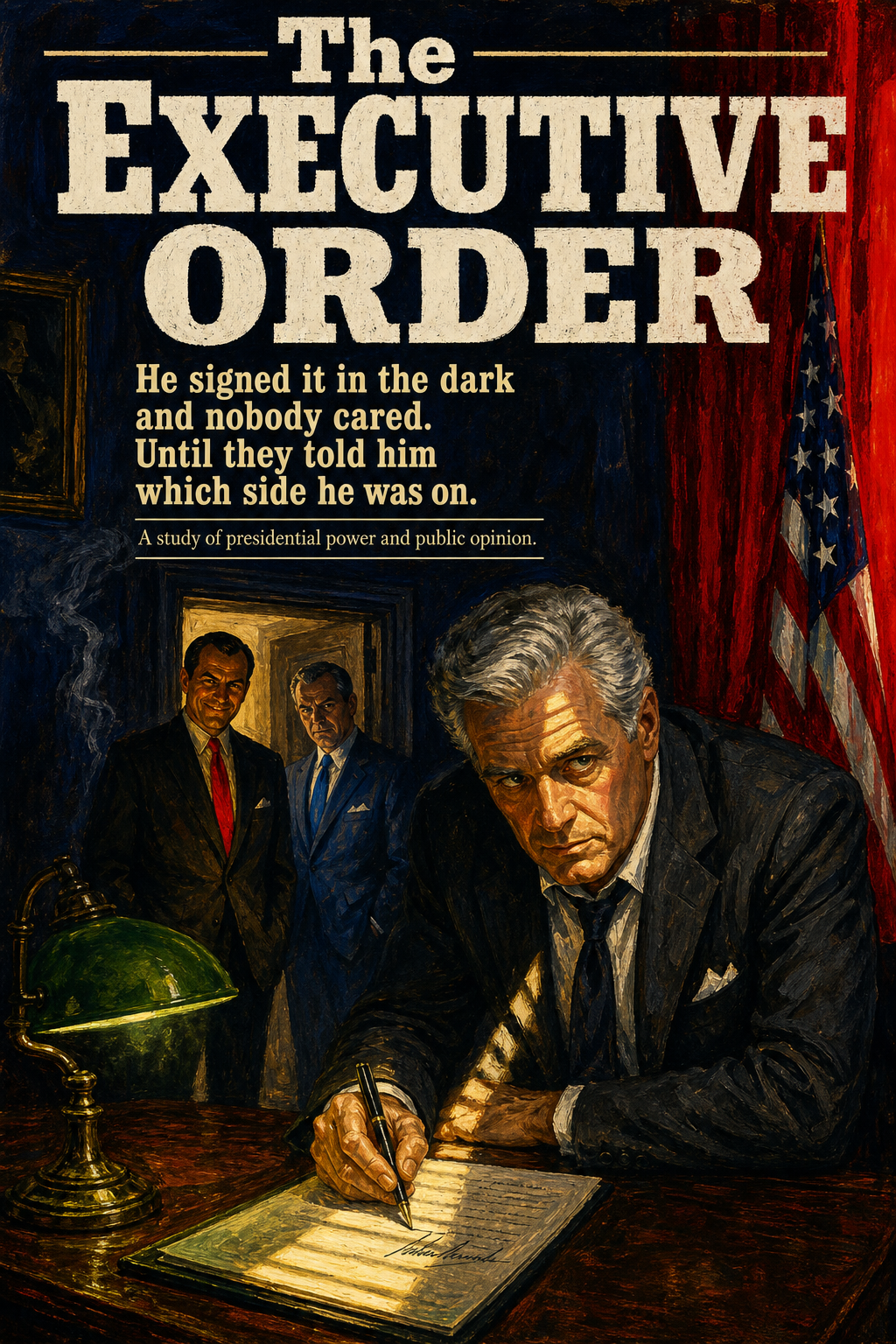
Why It Matters
The publication begins with a motivating question: To what extent are public attitudes toward presidential unilateral action sensitive to contextual factors such as the president's identity, the unilateral tool used, justifications for action, and the policy pursued?
Its central contribution is to show that survey experiments show that public support for presidential unilateral action is generally stable and not strongly affected by contextual factors, except when explicitly political considerations are invoked.
It matters because the findings connect institutional choices to the way authority, public responsibility, and political behavior are experienced in practice.
Key Findings
- Public support for unilateral presidential action is generally low and stable across most contextual variations.
- Contextual factors such as the president's identity, the specific unilateral tool, or legal/historical justifications have little effect on support, except when political or partisan factors are made salient.
- Support for unilateral action increases when the president's policy is supported by a large majority of the public or aligns with the respondent's own views.
- Partisan and policy context can condition support, but these effects are generally small or infrequent.
Research Design
- Design
- Article
- Data
- Survey data collected from Amazon Mechanical Turk (MTurk) participants in July and August 2016.
- Geography
- United States
- Time Period
- July–August 2016
- Unit of Analysis
- individual survey respondent
- Methods
- Series of survey experiments with over 7,500 respondents recruited via Amazon Mechanical Turk (MTurk).; Random assignment to baseline or contextual variation conditions in survey questions about support for unilateral presidential action.; Analysis of treatment effects comparing support across different contextual framings.
Full Abstract
This article reports a series of survey experiments (N > 7,500) examining whether public support for presidential unilateral action is sensitive to contextual factors such as the president's identity, the unilateral tool used, justifications for action, and the policy pursued. The authors find little evidence that context affects attitudes toward unilateral powers except in circumstances that invoke explicitly political factors. The findings suggest that public attitudes toward unilateral power are generally stable and have implications for understanding how public opinion constrains presidential power.
Citation
Reeves, Andrew, Jon C. Rogowski, Min Hee Seo, and Andrew R. Stone. 2017. "The Contextual Determinants of Support for Unilateral Action." Presidential Studies Quarterly 47(3): 448–470. doi:10.1111/psq.12391.
- Venue
- Presidential Studies Quarterly
- Volume
- 47
- Issue
- 3
- Pages
- 448–470
- DOI
- 10.1111/psq.12391