Unilateral Inaction: Congressional Gridlock, Interbranch Conflict, and Public Evaluations of Executive Power
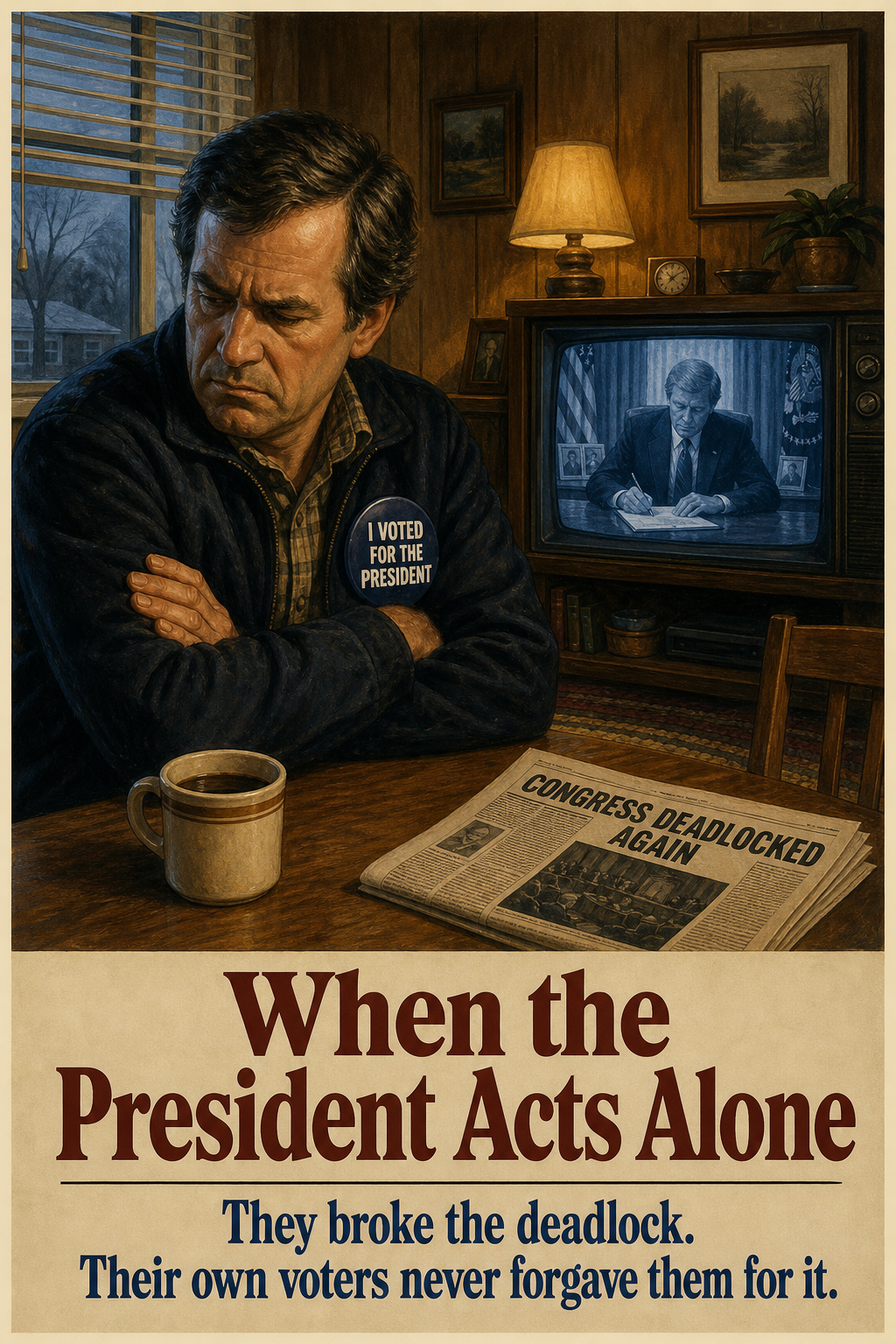
Survey experiments show that Americans generally respond negatively when presidents use unilateral power to enact policy during congressional gridlock, even when they agree with the president’s policy goals.
Why It Matters
The publication begins with a motivating question: How does the public evaluate presidents who use unilateral power to enact policy in the context of congressional gridlock and inaction, especially compared to presidents who accept the status quo?
Its central contribution is to show that survey experiments show that Americans generally respond negatively when presidents use unilateral power to enact policy during congressional gridlock, even when they agree with the president’s policy goals.
It matters because the findings connect institutional choices to the way authority, public responsibility, and political behavior are experienced in practice.
Key Findings
- The public responds negatively when presidents use unilateral power to enact policy rather than accept the status quo, even when the public agrees with the president’s policy views.
- Negative effects of unilateral action are largest among individuals who oppose the president’s policy views, but are also generally negative among supporters.
- Commitment to the rule of law increases negative reactions to unilateral presidential action.
- Presidents incur aggregate reductions in public evaluations for using unilateral action rather than retaining the status quo.
Research Design
- Design
- Article
- Data
- YouGov survey administered in March 2018 with approximately 4000 respondents representative of the US population.
- Geography
- United States
- Time Period
- March 2018 (survey fielding)
- Unit of Analysis
- individual survey respondent
- Methods
- Survey experiments with a nationally representative sample of approximately 4000 Americans.; Embedded experimental vignettes covering three policy areas: health care, international sanctions, and immigration.; Random assignment to conditions where the president either acts unilaterally or accepts the status quo after congressional inaction.; Between- and within-respondent analyses of treatment effects.
Full Abstract
Presidents routinely overpromise and underdeliver, especially amid partisan polarization, narrow congressional majorities, and persistent gridlock. As Congress routinely stymies their legislative agendas, presidents consider alternative courses of action. We study public reactions to unilateral power in the context of congressional inaction. While some research suggests that presidents cannot afford to pass up opportunities to act, more recent scholarship indicates that the public holds negative views of unilateral power and disapproves of its use. Survey experiments conducted with a national sample of Americans provide evidence of the costs of unilateral power. Across three policy areas and between- and within-respondent analyses, the public responds negatively when presidents exercise unilateral power rather than accept the status quo, even among individuals who share the president’s policy views. Our results suggest that while legislative gridlock may increase the appeal of unilateral power, its use may come at a public cost.
Citation
Reeves, Andrew, and Jon C. Rogowski. 2022. "Unilateral Inaction: Congressional Gridlock, Interbranch Conflict, and Public Evaluations of Executive Power." Legislative Studies Quarterly 47(2): 427-457. doi:10.1111/lsq.12353.
- Venue
- Legislative Studies Quarterly
- Volume
- 47
- Issue
- 2
- Pages
- 427-457
- DOI
- 10.1111/lsq.12353