Partisanship, Economic Assessments, and Presidential Accountability
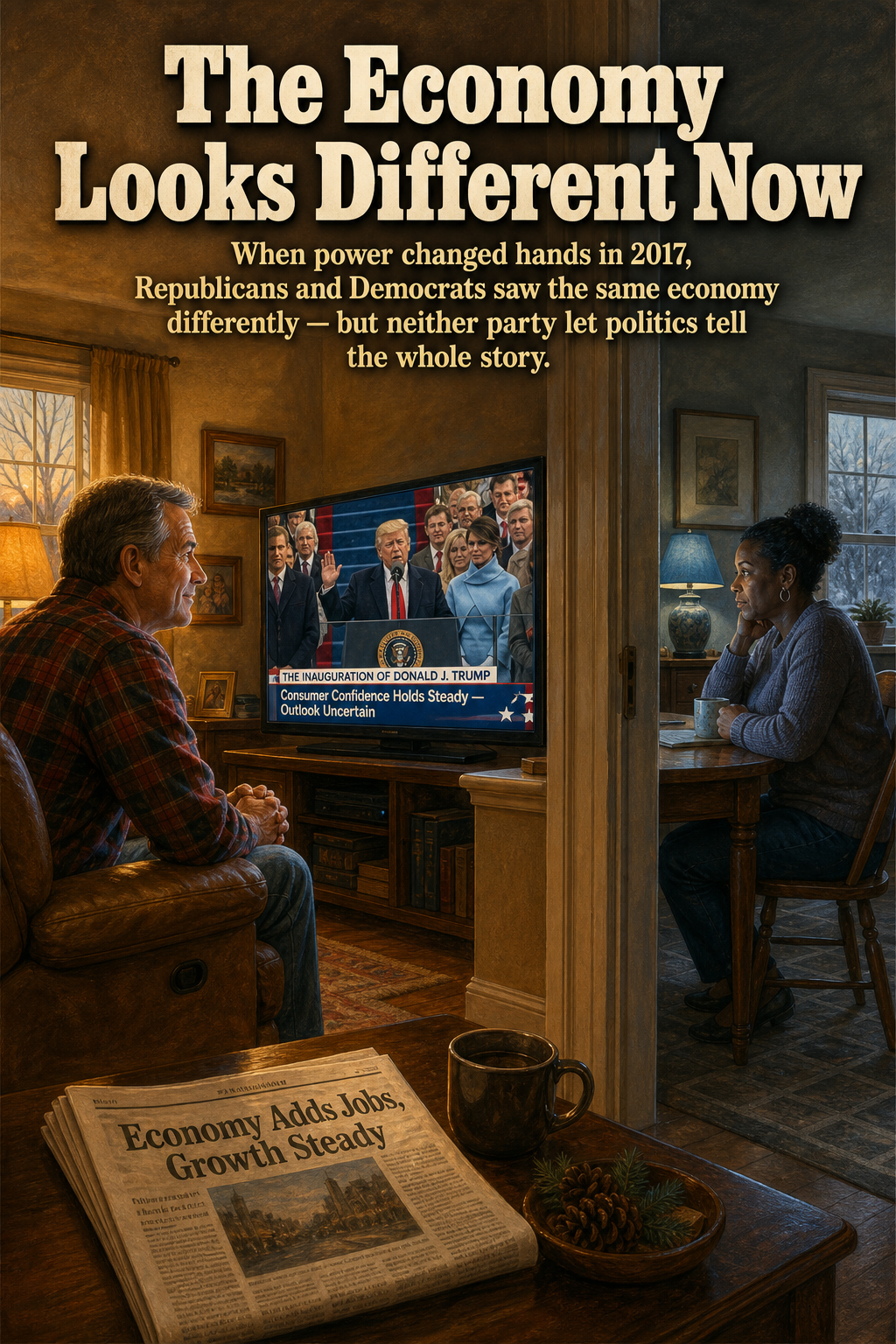
This study finds that while partisanship influences Americans' economic assessments following a change in presidential party, the effects are statistically significant but modest, suggesting partisanship does not seriously undermine presidential accountability.
Why It Matters
The publication begins with a motivating question: How does partisan control of the presidency affect Americans' perceptions of economic conditions?
Its central contribution is to show that this study finds that while partisanship influences Americans' economic assessments following a change in presidential party, the effects are statistically significant but modest, suggesting partisanship does not seriously undermine presidential accountability.
It matters because the findings connect institutional choices to the way authority, public responsibility, and political behavior are experienced in practice.
Key Findings
- Individual-level economic perceptions are largely stable across time.
- The change in partisan control of the White House after the 2016 election led to more positive economic evaluations among Republicans and more negative evaluations among Democrats.
- These partisan effects are statistically significant but substantively modest in magnitude.
- Partisanship is less strongly associated with economic assessments than some previous scholarship has claimed.
- Partisanship does not seriously undermine presidential accountability through blind reactions to election outcomes.
Research Design
- Design
- Article
- Data
- The American Panel Survey (TAPS), a monthly panel survey with a national probability sample.
- Geography
- United States
- Time Period
- September 2016 to January 2018
- Unit of Analysis
- individual survey respondent
- Methods
- Eight waves of panel survey data from a national probability sample (The American Panel Survey, TAPS) around the 2016 presidential election.; Linear regression models with respondent fixed effects.; Analysis of changes in economic perceptions before and after the 2016 election and inauguration.
Full Abstract
Few issues are more salient for voters or more important in political decision making than economic conditions, and no American public official is more closely associated with the economy than the president. Existing scholarship disagrees, however, about how partisan loyalties affect economic evaluations. We study how partisan control of the presidency affects economic perceptions using eight waves of panel data collected around the 2016 presidential election from a national probability sample. We find that although individual-level perceptions are largely stable across time, the change in partisan control of the White House was associated with more positive evaluations among Republicans and more negative evaluations among Democrats. These effects are statistically significant yet substantively modest in magnitude. Our results indicate that partisanship is less strongly associated with economic assessments than some previous scholarship has claimed and suggest more sanguine conclusions about the prospects for presidential accountability even in a partisan era.
Citation
Ang, Zoe, Andrew Reeves, Jon C. Rogowski, and Arjun Vishwanath. 2022. "Partisanship, Economic Assessments, and Presidential Accountability." American Journal of Political Science 66(2): 468–484. https://doi.org/10.1111/ajps.12659
- Venue
- American Journal of Political Science
- Volume
- 66
- Issue
- 2
- Pages
- 468–484
- DOI
- 10.1111/ajps.12659