Local Unemployment and Voting for President: Uncovering Causal Mechanisms
This study finds that both mediated economic voting and issue-ownership voting mechanisms link local unemployment to presidential voting, with rising local unemployment increasing support for Democratic candidates but decreasing support for incumbents through perceptions of the national economy.
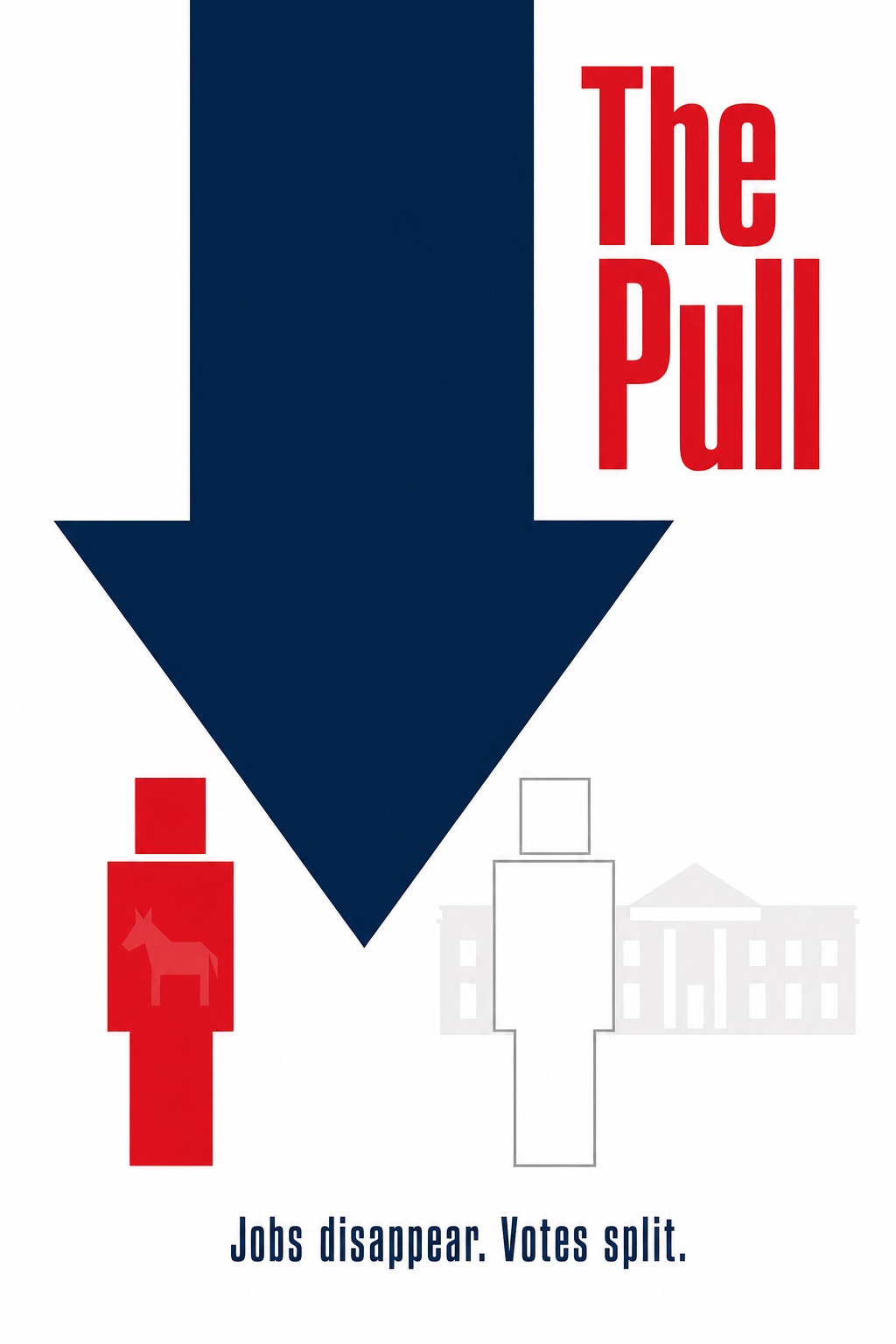
Why It Matters
The publication begins with a motivating question: How does local unemployment influence presidential voting, and through what causal mechanisms does this effect operate?
Its central contribution is to show that this study finds that both mediated economic voting and issue-ownership voting mechanisms link local unemployment to presidential voting, with rising local unemployment increasing support for Democratic candidates but decreasing support for incumbents through perceptions of the national economy.
It matters because the findings connect institutional choices to the way authority, public responsibility, and political behavior are experienced in practice.
Key Findings
- Both mediated local economic voting and local issue-ownership voting mechanisms are at work in presidential elections.
- Rising local unemployment increases support for Democratic presidential candidates (issue-ownership effect).
- Rising local unemployment decreases support for the incumbent president, Democrat or Republican, through its effect on perceptions of the national economy (mediated effect).
- These two mechanisms can counterbalance each other, explaining frequent null findings for the total effect of local unemployment on presidential voting.
Research Design
- Design
- Causal mediation analysis using a potential outcomes framework to decompose total effects into direct and indirect (mediated) effects, controlling for pretreatment covariates.
- Data
- Cooperative Congressional Election Study (CCES) surveys from 2008, 2012, and 2016; County-level unemployment statistics from the Bureau of Labor Statistics (LAUS)
- Geography
- United States (county-level analysis)
- Time Period
- 2008, 2012, and 2016 U.S. presidential elections
- Unit of Analysis
- Individual survey respondent (linked to county-level data)
- Methods
- Individual-level mediation analysis using causal mediation analysis within a potential outcomes framework.; Analysis of the 2008, 2012, and 2016 U.S. presidential elections using survey data.
Full Abstract
How does local unemployment influence presidential elections? Some argue that, for voters, the state of the local economy is an afterthought to that of the national economy. On the other hand, those who argue that local unemployment matters fall into two camps. Recent research finds that local unemployment is a reputation issue that benefits Democratic candidates because voters believe they are the party best equipped to deal with the issue. Alternatively, others have posited that the local economy provides voters with information for evaluating the governing party’s job performance. This view holds that the incumbent party, Democrat or Republican, will be punished when local unemployment is high. In this article, we investigate these distinct mechanisms jointly. In an individual-level mediation analysis of the 2008, 2012, and 2016 presidential elections, we present evidence that both mechanisms are at work. Rising local unemployment bolsters support for Democratic presidential candidates, but, through its influence on views of the national economy, drives down support for the incumbent, Democrat or Republican.
Citation
Park, Taeyong & Reeves, Andrew. (2020). Local Unemployment and Voting for President: Uncovering Causal Mechanisms. Political Behavior, 42(2), 443-463. https://doi.org/10.1007/s11109-018-9502-4
- Venue
- Political Behavior
- Volume
- 42
- Issue
- 2
- Pages
- 443-463
- DOI
- 10.1007/s11109-018-9502-4