Polling Place Quality and Access
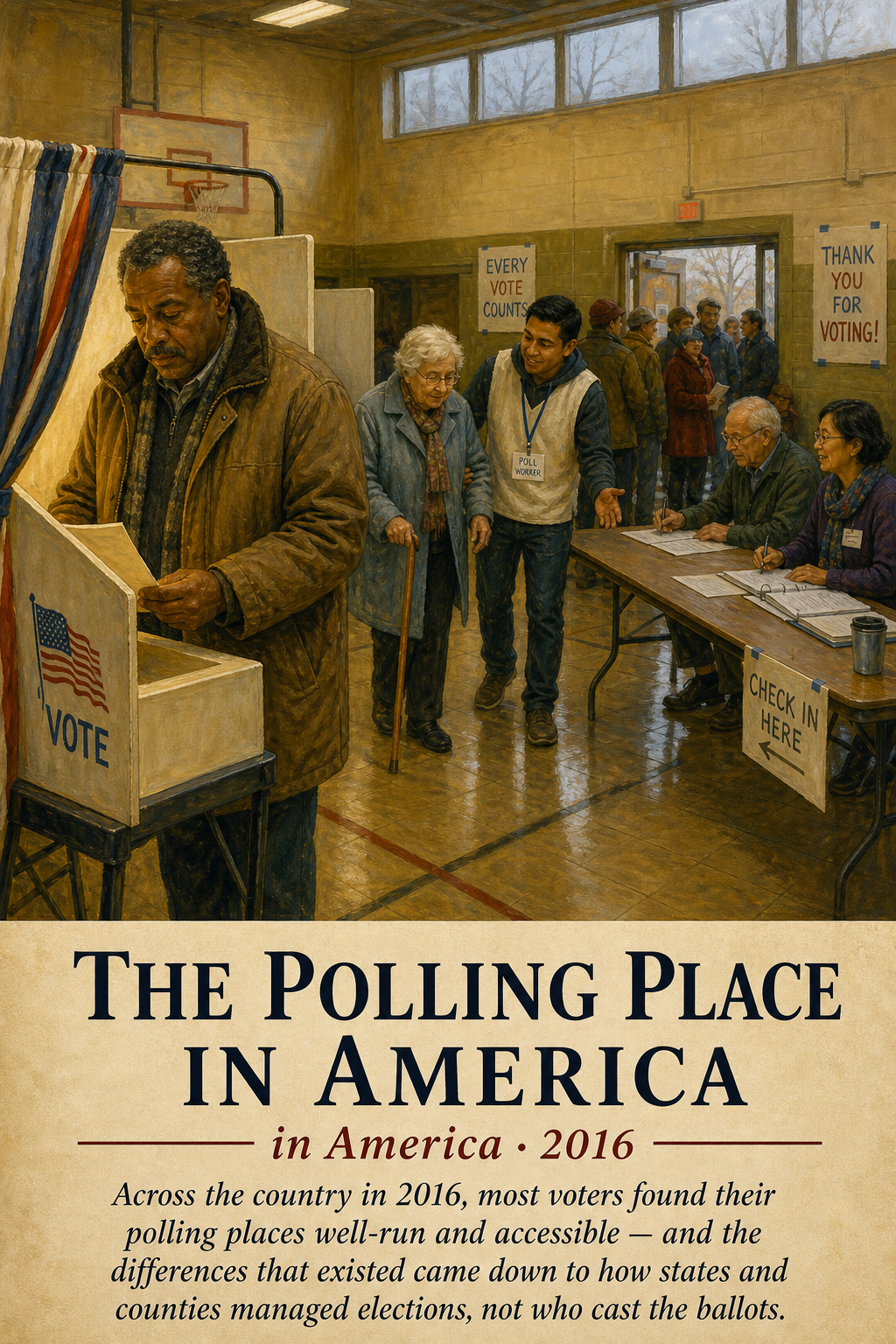
A national study of 528 polling places in 26 jurisdictions during the 2016 U.S.
Why It Matters
The publication begins with a motivating question: S. jurisdictions, and are these variations attributable to racial, ethnic, or socioeconomic composition of voters or to jurisdictional factors?
Its central contribution is to show that a national study of 528 polling places in 26 jurisdictions during the 2016 U.S.
It matters because the findings connect institutional choices to the way authority, public responsibility, and political behavior are experienced in practice.
Key Findings
- Polling places in the 2016 national sample were generally accessible, well-managed, and had few barriers to voting.
- There was little evidence that polling place accessibility, quality, or barriers varied by race, ethnicity, or socioeconomic composition of voters.
- Most variation in polling place attributes was attributable to county and state (jurisdictional) factors rather than within-county differences.
Research Design
- Design
- Chapter
- Data
- Direct observation of 528 polling places by research teams.; Demographic data from Catalist (2016) for precinct-level analysis.
- Geography
- United States (26 jurisdictions in 17 states)
- Time Period
- 2016 U.S. presidential election (November 8, 2016)
- Unit of Analysis
- Polling place
- Methods
- Multi-jurisdictional observational study of polling places during the 2016 U.S. presidential election.; Random and convenience sampling of polling places in 26 jurisdictions across 17 states.; Student researchers observed and recorded polling place attributes using standardized protocols and forms.; Regression analysis to assess the relationship between polling place attributes and demographic variables, with and without county fixed effects.
Citation
Stein, R., Mann, C., & Stewart III, C. (2020). Polling Place Quality and Access. In M. Brown, K. Hale, & B. A. King (Eds.), The Future of Election Administration (pp. 83-100). https://doi.org/10.1007/978-3-030-14947-5_6
- Venue
- The Future of Election Administration, Palgrave Macmillan
- Pages
- 83-100
- DOI
- 10.1007/978-3-030-14947-5_6