Pass the Buck or the Buck Stops Here? The Public Costs of Claiming and Deflecting Blame in Managing Crises
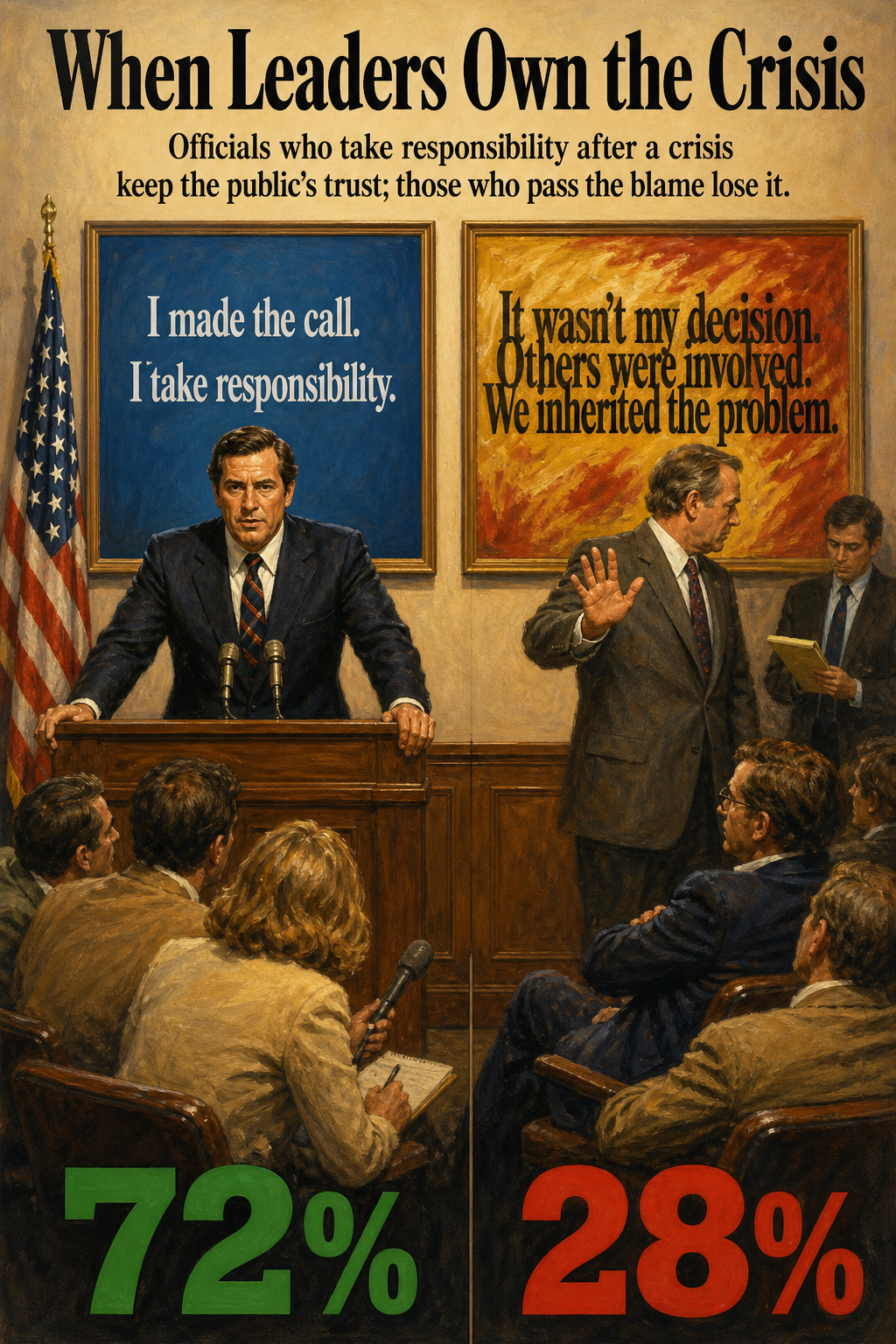
Survey experiments show that elected executives who claim blame during crises maintain higher public support than those who deflect blame, primarily by enhancing perceptions of their leadership.
Why It Matters
The publication begins with a motivating question: How do elected executives’ presentational strategies—specifically blame claiming versus blame deflecting—affect public support in the aftermath of governmental crises?
Its central contribution is to show that survey experiments show that elected executives who claim blame during crises maintain higher public support than those who deflect blame, primarily by enhancing perceptions of their leadership.
It matters because the findings connect institutional choices to the way authority, public responsibility, and political behavior are experienced in practice.
Key Findings
- Blame claiming by elected executives is more effective than blame deflecting at maintaining public support after crises.
- Blame claiming improves perceptions of an executive’s leadership valence.
- Blame deflecting induces a null or negative effect on public evaluations of executives.
- These results persist even when accounting for crisis severity and partisanship.
- Causal mediation analysis shows that leadership valence mediates the positive effect of blame claiming.
Research Design
- Design
- Article
- Data
- The American Panel Survey (TAPS), a nationally representative US panel survey.; Amazon Mechanical Turk (MTurk) samples for additional experiments.
- Geography
- United States
- Unit of Analysis
- survey respondent
- Methods
- Survey experiments using stylised and real-world crisis scenarios.; Random assignment of respondents to blame claim, blame deflect, or control conditions.; Measurement of approval, likelihood to vote, and perceptions of leadership valence.
Full Abstract
When things go wrong, and the government may be to blame, the public support enjoyed by elected executives is vulnerable. Because attribution of responsibility is often not straightforward, elected executives can influence citizens’ evaluations of their performance through presentational strategies, or explanatory frames which describe their roles in the management of the crisis. We examine the effectiveness of two ubiquitous presentational strategies: blame claiming, where the executive accepts responsibility, and blame deflecting, where the executive shifts blame to others. Using survey experiments incorporating stylised and real-world stimuli, we find that blame claiming is more effective than blame deflecting at managing public support in the aftermath of crises. In investigating the underlying mechanism, we find that blame claiming creates more favourable views of an executive’s leadership valence. While elected executives are better off avoiding crises, we find that when they occur, “stopping the buck” is a superior strategy to deflecting blame.
Citation
Miller, David R., and Andrew Reeves. 2022. "Pass the Buck or the Buck Stops Here? The Public Costs of Claiming and Deflecting Blame in Managing Crises." Journal of Public Policy 42(1): 63-91. doi:10.1017/S0143814X21000039.
- Venue
- Journal of Public Policy
- Volume
- 42
- Issue
- 1
- Pages
- 63–91
- DOI
- 10.1017/S0143814X21000039