Review of The Unheavenly Chorus: Unequal Political Voice and the Broken Promise of American Democracy by Kay Lehman Schlozman, Sidney Verba, and Henry E. Brady
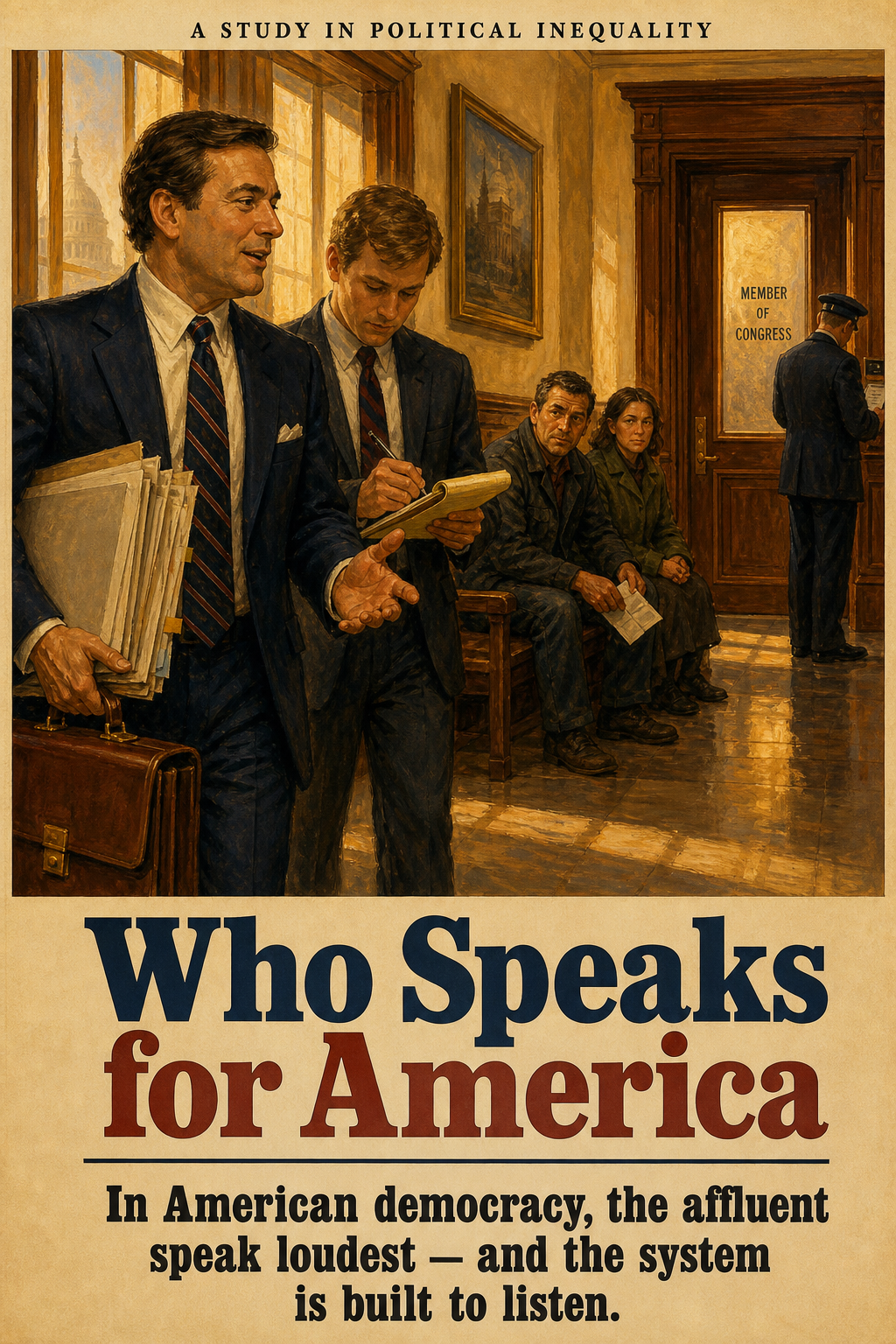
The Unheavenly Chorus documents persistent and severe inequalities in American political voice, showing that both individual and organized interest participation are strongly skewed toward the privileged, with little change over time.
Why It Matters
The publication begins with a motivating question: Who has political voice in America today, and how is this voice distributed among individuals and organized interests?
Its central contribution is to show that the Unheavenly Chorus documents persistent and severe inequalities in American political voice, showing that both individual and organized interest participation are strongly skewed toward the privileged, with little change over time.
It matters because the findings connect institutional choices to the way authority, public responsibility, and political behavior are experienced in practice.
Key Findings
- Socioeconomic status (SES) is positively related to nearly every form of political participation.
- The relationship between SES and political participation is stable over time and persists at both local and national levels.
- Technological changes, such as the Internet, have not reduced SES-based inequalities in political participation.
- The majority of organized interests represent privileged groups, with very few representing the less-privileged.
- The number of organized interest groups has increased dramatically, but the distribution remains skewed toward privileged interests.
Research Design
- Design
- Review
- Data
- Citizen Participation Study of 1990; American National Election Studies (1952–2008); Roper surveys (1970–2003); Washington Directory (for organized interest groups)
- Geography
- United States
- Time Period
- 1952–2008 (individual participation); 1981–2006 (organized interests)
- Unit of Analysis
- Individuals and organized interest groups
- Methods
- Analysis of survey data, including the Citizen Participation Study of 1990 and American National Election Studies (1952–2008) and Roper surveys (1970–2003).; Comprehensive data collection on over 35,000 organized interest groups from 1981, 1991, 2001, and 2006, primarily using the Washington Directory and categorization of groups.
Citation
Reeves, Andrew. 2013. "Review of The Unheavenly Chorus: Unequal Political Voice and the Broken Promise of American Democracy by Kay Lehman Schlozman, Sidney Verba, and Henry E. Brady." The Forum 11(1): 63-67.
- Venue
- The Forum
- Volume
- 11
- Issue
- 1
- Pages
- 63-67