The Persistence of Localism in an Era of Nationalized Politics
Shows how national party labels increasingly organize American politics while local environments continue to shape what those labels mean and which policies partisans support.
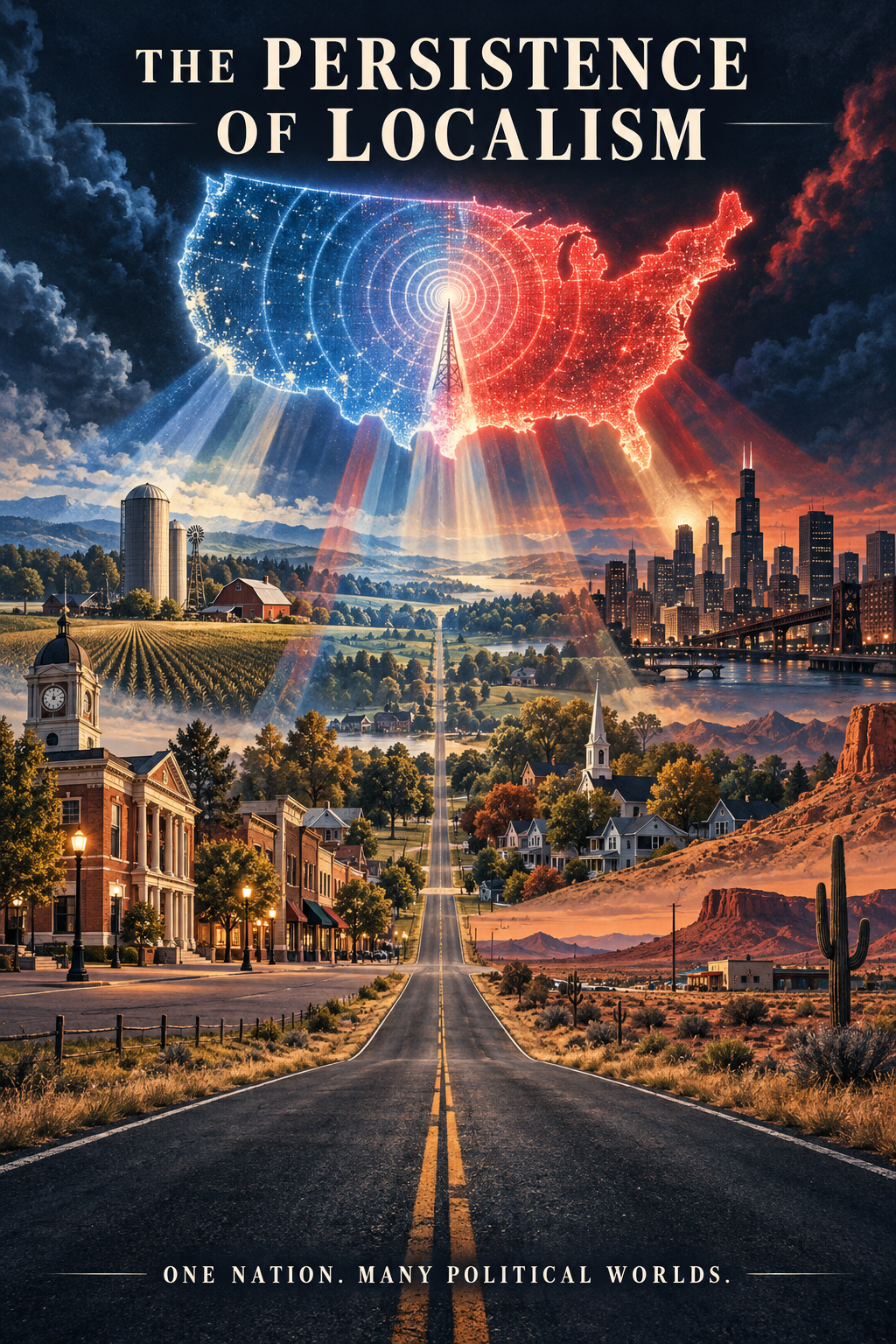
Why It Matters
This chapter asks how local political environments can remain consequential when American elections, media, and party conflict have become increasingly nationalized.
Its central contribution is to distinguish convergence in political form from persistence in political substance: national party labels supply a common vocabulary, but local social, economic, and institutional conditions continue to shape what that vocabulary means.
The argument matters because national parties govern coalitions whose members may share a label and candidates while holding systematically different priorities rooted in the places where they live.
Key Findings
- Electoral outcomes become more dispersed, not less, as analysis moves from the nation to states, counties, and more local geographic units.
- The urban-rural divide structures how people experience and interpret national political conflict.
- Place-based differences persist within parties, especially on guns, environmental policy, immigration, reproductive policy, and public spending.
- Nationalization has reorganized localism within national parties rather than eliminating it.
Research Design
- Design
- County-level electoral distributions and survey analysis
Citation
In Handbook on American Political Geography, edited by Nicholas F. Jacobs and Kal Munis. Berlin, Germany: De Gruyter. Forthcoming.
- Venue
- Handbook on American Political Geography