Review of The State of Disunion: Regional Sources of Modern American Partisanship by Nicole Mellow
This review discusses Nicole Mellow's argument that regional interests are central to understanding modern American partisanship, highlighting both the strengths and limitations of her evidence and conceptualization of regions.
Why It Matters
The publication begins with a motivating question: Are regions important in understanding American politics, particularly in shaping modern American partisanship?
Its central contribution is to show that this review discusses Nicole Mellow's argument that regional interests are central to understanding modern American partisanship, highlighting both the strengths and limitations of her evidence and conceptualization of regions.
It matters because the findings connect institutional choices to the way authority, public responsibility, and political behavior are experienced in practice.
Key Findings
- Regions are largely responsible for the state of party politics today by directing politicians' motives and determining issues.
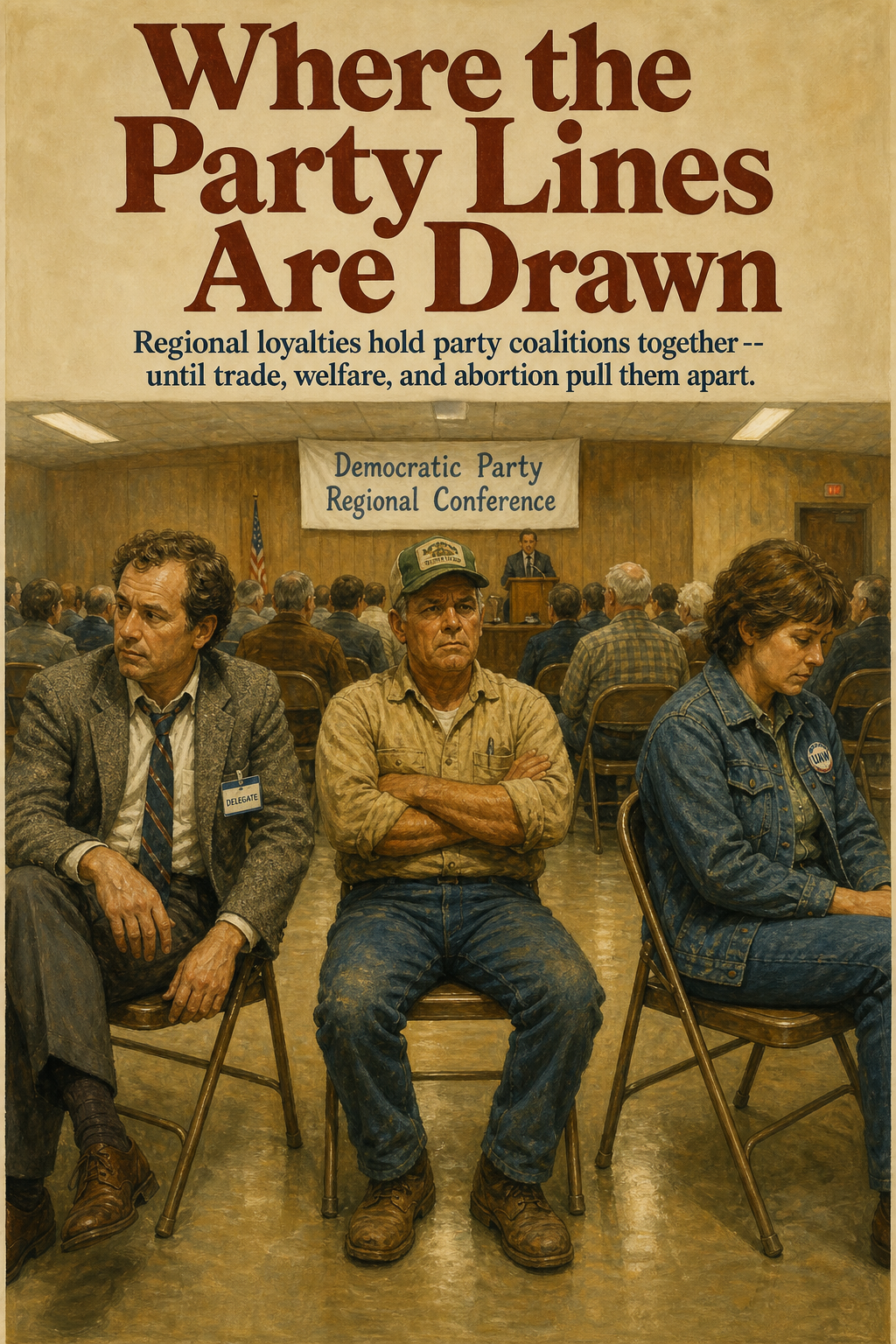
- Regional interests influence party cohesion on issues like free trade, welfare reform, and abortion.
- The evidence for the independent effect of region is limited and sometimes equivocal, with small sample sizes and somewhat arbitrary regional definitions.
Research Design
- Design
- Review
- Geography
- United States (with regional breakdowns such as North, South, West, Pacific, New England, etc.)
- Time Period
- 1950s to present (as of 2008)
- Unit of Analysis
- Region (as defined by the author, e.g., North, South, etc.) and legislative behavior
- Methods
- Comparative analysis of party positions on key issues (free trade, welfare reform, abortion) across regions.; Multivariate regression analysis (noted as being based on a small sample of 40 cases).
Citation
Reeves, Andrew. 2009. "Review of The State of Disunion: Regional Sources of Modern American Partisanship by Nicole Mellow." Political Science Quarterly 124(4): 743-744.
- Venue
- Political Science Quarterly
- Volume
- 124
- Issue
- 4
- Pages
- 743-744